
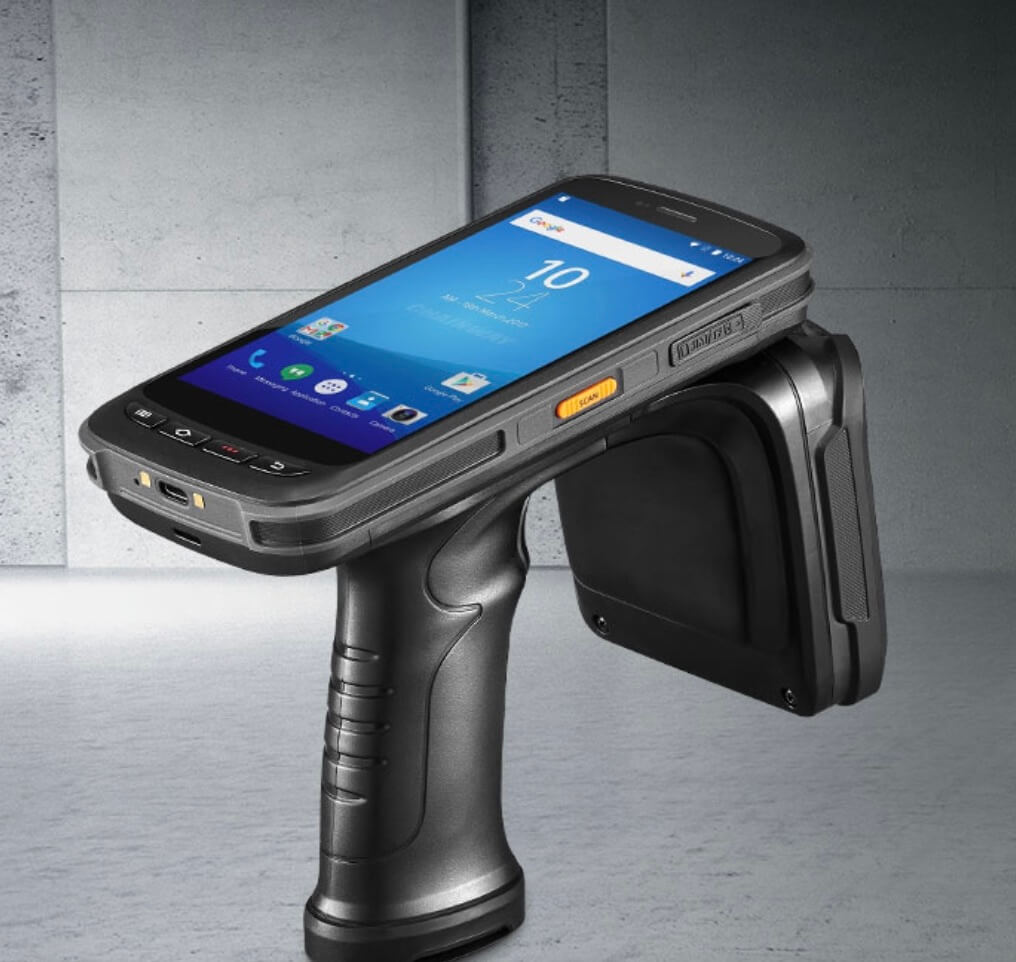
If you're moving dental inventory off paper and clipboards, you'll quickly face a choice: barcode scanning or RFID. Both identify products and feed a count into software. The difference is in how the count happens, and that decides whether inventory keeps taking hours of staff time every week or takes minutes.
How barcode scanning works
A barcode is a printed label read by light. To count an item, someone has to find it, turn it so the label faces the scanner, and scan it, one item at a time.
- Line of sight is required: the scanner has to see the label. Items at the back of a drawer, inside a closed box, or with the label facing the wall have to be moved.
- One read at a time: counting 40 boxes means 40 scans.
- The count is only as good as the person scanning: anything that isn't found, handled and scanned simply isn't counted.
How RFID works
RFID (radio-frequency identification) uses a small tag with a chip and an antenna. A handheld reader sends out a radio signal, and every tag within range answers with its ID at once.
- No line of sight: the reader picks up tags through cabinet doors, boxes and packaging, so supplies stay where they are.
- Many reads at once: the reader can read a whole shelf or drawer in seconds rather than item by item.
- Tagging fits into restocking: each item gets a small tag when it's put away, and from then on it's counted automatically every time the reader passes.
The comparison, side by side
- Time to count the office: barcode counts take hours in a busy office because every item is handled. With RFID, a staff member walks through the rooms with the reader and the count is done in minutes.
- Accuracy: barcode counts depend on people finding and scanning every item, and skipped or double-scanned items are common. RFID counts don't depend on handling each box, so they're more complete and more consistent from one count to the next.
- How often you can count: because barcode counts are slow, most offices do them monthly or less, and numbers drift in between. Because RFID counts are fast, you can count weekly or more, so the numbers stay close to reality.
- Finding things: with a barcode, you know an item is "somewhere" in the office. RFID readers can work like a Geiger counter, guiding you to a specific tagged item.
- Real cost: barcode labels are cheap, but the hours of staff time every count, the items missed, and the orders built on stale numbers are not. Compare the total cost, including staff time, not just the price of a label.
Why barcode systems stall in dental offices
Many offices try barcode scanning and drift back to the clipboard. The reasons are predictable:
- Counts still take hours, because every box must be found, turned and scanned. So counts happen monthly or less, and the numbers are out of date when it's time to order.
- Supplies are everywhere: operatories, sterilization, the lab and overflow storage. Every location means more walking and more items to handle.
- Partial counts creep in. When a full count takes too long, teams count only "the important stuff", and everything else becomes a guess.
- Barcodes don't help you find things. You know an item is somewhere in the office, but not where.
Signs your office is ready for RFID
If any of these sound familiar, RFID will pay for itself in staff time and avoided waste:
- Counts take hours, or happen so rarely that stock levels are a guess.
- Supplies are spread over several operatories, storage areas or locations.
- Expensive items, such as implant components or grafting materials, need to be tracked closely.
- Items regularly expire on the shelf or run out mid-procedure.
What to look for in an RFID system
Not all RFID systems are alike. A common approach in dental and medical settings uses RFID cabinets or lockers, which means buying new storage and reorganizing the office around it. Ask any vendor:
- Does it work with my existing storage? Or do I need special cabinets?
- How are tags applied, and who does it when supplies arrive?
- What happens after the count: low-stock and expiration alerts, reports, reordering?
- Can I see every location in one place if I run more than one office?
DTrackAll uses an ergonomic RFID handheld with your existing shelves, drawers and cabinets, with no lockers or special storage. A staff member walks the office with the reader, the count is done in minutes, and DTrackAll turns it into real-time stock levels, alerts for low stock and upcoming expirations, and a ready-to-send reorder.
For the bigger picture, read Dental Inventory Management: The Complete Guide, covering why manual methods break down, how methods compare, DSOs and what to measure.
See the difference yourself. Book a demo and we'll show you a full RFID count of a dental office from start to finish.